· 1 min read · Arstar IT · Gaming Compliance · 4 min read
Arstar IT enables game development services under Puerto Rico's Gaming Commission technical standard
Puerto Rico's route-machine market runs on its own technical standard, not a plain GLI-11 pass. We've enabled game development for it — and two operators racing for island market share are already manufacturing up to 40% of their own slot floor with us.
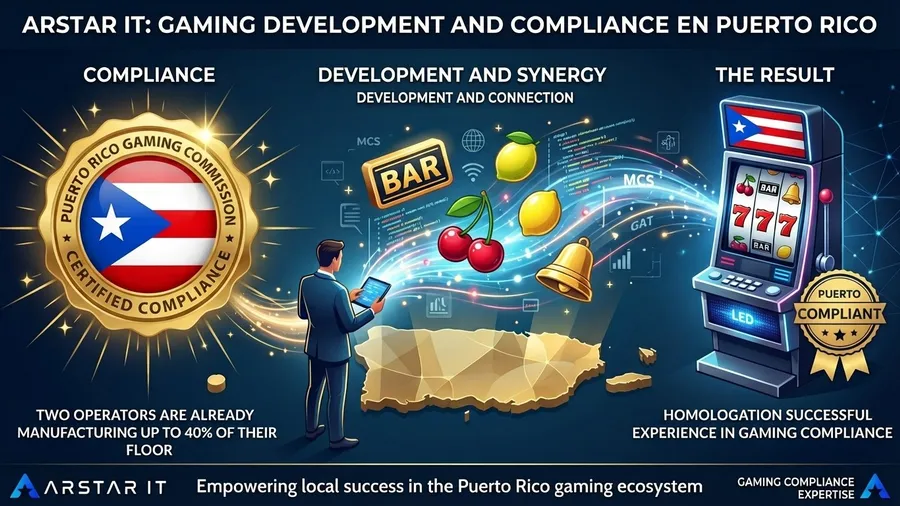
Puerto Rico regulates its route-machine market — the slot machines installed outside casinos, known locally as MAJAR — through its own Gaming Commission technical standard, not a generic GLI-11 pass-through. Arstar IT has enabled game development services built around that specific standard, and we’re already running it for two operators who have positioned themselves at the front of the race for market share on the island.
It’s not just GLI-11
Since 1 January 2026, every gaming device submitted for approval in Puerto Rico must carry a Gaming Authentication Terminal (GAT): a mechanism that lets the Commission remotely verify every program storage device through an approved communication port, inside the locked logic area, using per-component SHA-1 HMAC signatures generated per NIST guidance. Verification has to run without powering the device off and complete within 20 minutes, and results have to stay retrievable even after a communication loss. Older devices with a communication port had to update their program storage to comply by the same date, unless the Commission approved an exception in writing.
On top of that, the Commission’s own independent testing laboratories run statistical RNG testing at a 99% confidence level, drawing at least 10,000 mechanical RNG results where feasible, before they’ll certify a device. None of that is part of a standard GLI-11 evaluation elsewhere — it’s layered on top of it, specific to Puerto Rico, and it’s where a game that’s technically solid everywhere else can still fail a Puerto Rico submission.
There’s a second layer beyond the game itself: since a December 2022 amendment to Act 11, every route operator or wholesale owner has to link all of its machines to an internal Monitoring and Control System (MCS), reporting equipment, platform, games and versions for each connected unit. The Commission opened the formal interconnection period in January 2026, giving operators 90 days to show they’d contracted a certified provider. That requirement reaches into the game’s own meters, accounting and protocol events — which is why we build to it from the first sprint rather than bolting it on before submission.
Why now
Puerto Rico’s Gaming Commission has spent the past year and a half moving the route-machine market from informal to enforced: more than 2,700 entities and roughly 15,000 devices were brought under licensing through Law 112-2024, and since July 2025 the Commission has run an active enforcement phase, with machines that lack a valid registration sticker facing fines of $5,000 to $10,000 each. A market that strict about paperwork is just as strict about the device itself — which is exactly where our game development and certification-readiness work lives.
Two operators, building instead of only importing
We’re already working with two operators who’ve chosen not to just bring machines onto the island, but to manufacture up to 40% of their own slot floor — a bet on owning more of the supply chain while the rest of the market is still racing to secure market share. That only works if what they build clears the Commission’s standard the first time, which is the part we own: game development built with Puerto Rico’s GAT and interconnection requirements in from day one, pre-lab testing to catch non-conformities before the laboratory does, and GLI certification project management to run the submission end to end.
Why they picked us
It wasn’t a cold pitch. These operators chose Arstar IT on our track record — more than a decade of projects across regulated gaming markets — and on our working relationship with the labs that actually certify these devices, GLI included. That relationship is what turns a certification submission into a project with a predictable timeline instead of a black box.
If you’re an operator or manufacturer looking at Puerto Rico’s technical standard and wondering whether your current build would clear a GAT and MCS submission, that question is answerable before you ship it.
Frequently asked questions
Is passing GLI-11 enough to sell route machines in Puerto Rico?
No. Puerto Rico's Gaming Commission layers its own Route Gaming Machines Technical Standard on top of a standard evaluation: a mandatory Gaming Authentication Terminal (GAT) for remote program storage verification, independent statistical RNG testing at a 99% confidence level, and mandatory interconnection to an internal Monitoring and Control System (MCS). A device that clears GLI-11 elsewhere can still fail a Puerto Rico submission on these points.
What is a Gaming Authentication Terminal (GAT)?
It's the mechanism Puerto Rico's Gaming Commission requires, from 1 January 2026, for remotely verifying a device's program storage through an approved communication port inside the locked logic area, using per-component SHA-1 HMAC signatures generated per NIST guidance. Verification must run without powering the device off, complete within 20 minutes, and results must stay retrievable even after a communication loss.
What is the Monitoring and Control System (MCS) requirement?
Following a December 2022 amendment to Act 11, every route operator or wholesale owner must link all of its machines to an internal MCS that reports equipment, platform, games and versions for each connected unit. The Commission opened the formal interconnection period in January 2026, giving operators 90 days to show they'd contracted a certified provider. The requirement reaches into the game's own meters, accounting and protocol events.
Why is Puerto Rico enforcing this now?
Law 112-2024 brought more than 2,700 entities and roughly 15,000 devices under formal licensing, and since July 2025 the Commission has run an active enforcement phase, with unregistered or unlicensed devices facing fines of $5,000 to $10,000 each.
Does Arstar IT manufacture slot machines?
No. We develop EGM and online games and prepare products for laboratory certification. The manufacturing is our clients' — two operators who have chosen to build up to 40% of their own slot floor rather than only import it, and who bring us in for the game development and certification-readiness work behind that.