· 1 min read · Arstar IT · Gaming Compliance · 4 min read
Peru sets technical rules for remote gaming platforms under the 1% wager tax
MINCETUR's Directive 001-2026 took effect on 24 November. It touches certified platform code, which makes it a certification problem as much as a tax one.
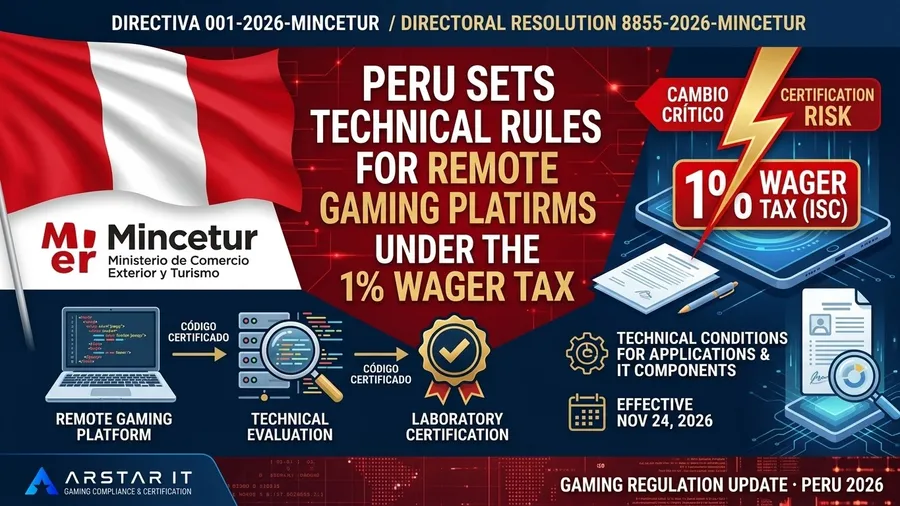
Peru’s Ministry of Foreign Trade and Tourism (MINCETUR) has approved the technical conditions that remote gaming and remote sports betting platforms must meet in connection with the Selective Consumption Tax. The measure was adopted through Directoral Resolution 8855-2026-MINCETUR/VMT/DGJCMT, which approves Directive 001-2026-MINCETUR/VMT/DGJCMT, published in the official gazette El Peruano on 23 November 2026 and applicable from the following day.
What the directive actually does
The headline in much of the trade press reads as though Peru has introduced a new technical regime for online gaming. It is narrower and more specific than that, and the distinction matters if you are the one who has to implement it.
The directive governs the use and functioning of the applications, services and IT components of the technological platform with respect to the ISC: the Selective Consumption Tax that applies to remote gaming and remote sports betting at a rate of 1% per wager. It does not create the tax. Legislative Decree 1644 brought these activities within the scope of the ISC, and Supreme Decree 254-2024-EF approved the regulation of the tax. What the directive adds is the operational layer: how the platform’s systems must behave so that the tax is calculated, applied and recorded as the regulation expects.
It is a compact instrument — eight articles across three chapters, two transitional and complementary provisions, and an annex — signed by the Director General of Casino Games and Slot Machines, the body that under Supreme Decree 005-2023-MINCETUR is the national authority for regulating, authorising, revoking, supervising and sanctioning remote gaming in Peru.
Why a tax rule is a certification problem
Here is the part that gets missed. Peru does not let an operator put any platform into the market. Under Law 31557 and its regulation, the technological platform, the game programs, the progressive systems, the integrations between platforms and the other components and services must undergo technical evaluation by a certification laboratory authorised by MINCETUR before authorisation and registration. The laboratory is given access to the source code of the platform, and the compiled result has to match the software that was submitted.
So when a directive obliges you to change how your platform computes and records a per-wager tax, you are not making a back-office accounting adjustment. You are modifying a system whose current state was evaluated and registered against a technical standard. The regulatory framework anticipates this: applications for authorisation and renewal require operators to describe their change management processes, including the procedures used to assess the criticality of platform updates.
That assessment is the whole game. Classify the change too lightly and you risk operating a platform that no longer matches what was certified. Classify it heavily and you are into a submission cycle with a deadline already behind you.
The pattern we see in every new market
Peru is following a sequence we have watched in Ukraine, South Africa and across Latin America. A market opens, the authorisation framework lands first, and then the fiscal and technical directives arrive in layers over the following years. Each layer is small on its own. Together they mean a platform that was certified two years ago is now carrying a stack of modifications that nobody has re-evaluated as a whole.
The operators that cope well with this have two things in place. The first is a change-management discipline that can answer, for any given modification, whether it touches certified behaviour. The second is the ability to test against the standard before the laboratory sees the build, because a failed submission is not just a fee — it is weeks of calendar time in a market where the commercial window is open now.
Where we fit
We are not a certification laboratory, and in Peru we could not be: the regulation requires laboratories to be independent of the platform owners they evaluate. We work on the other side of that relationship, with the manufacturers and operators who have to get through it.
Pre-lab testing is the work of finding the non-conformities before the laboratory does. We run your product against the applicable standards, document what fails and why, and hand back a product that is ready to submit. It is the difference between one submission and three.
Certification project management is for when the bottleneck is not the engineering but the process: the submission package, the communication with the laboratory, the test rounds, the evidence, the regulator’s questions. We have been doing this alongside GLI’s headquarters for over twenty years, across more than forty certified products on four continents.
If you are a supplier or operator in Peru looking at Directive 001-2026 and wondering whether the change you are about to ship puts your registration at risk, that question is answerable before you ship it.
Sources: Resolución Directoral N° 8855-2026-MINCETUR/VMT/DGJCMT, El Peruano · Ley N° 31557 · Decreto Supremo N° 005-2023-MINCETUR
Frequently asked questions
What exactly did MINCETUR approve?
Directive 001-2026-MINCETUR/VMT/DGJCMT, approved by Directoral Resolution 8855-2026-MINCETUR/VMT/DGJCMT. It regulates the use and functioning of applications, services and IT components in the technological platforms of remote gaming and remote sports betting, in respect of the Selective Consumption Tax. It runs to eight articles across three chapters, with two transitional and complementary provisions and an annex.
When did it come into force?
It was published in El Peruano on 23 November 2026 and applies from 24 November 2026, the day after publication.
Does it create a new tax on online betting in Peru?
No. The Selective Consumption Tax on remote gaming and remote sports betting already existed: Legislative Decree 1644 brought these activities within its scope, and Supreme Decree 254-2024-EF approved the tax regulation. The directive does not create the tax or change the rate. It sets the technical conditions the platform systems must meet so the tax is applied, calculated and recorded correctly.
Who does it apply to?
Operators of remote gaming and remote sports betting authorised to operate in Peru, in relation to how their platforms handle the tax.
Does Peru require platform certification by a laboratory?
Yes, and that requirement predates this directive. Under Law 31557 and its regulation, Supreme Decree 005-2023-MINCETUR, the technological platform, game programs, progressive systems, platform integrations and other components must undergo technical evaluation by a certification laboratory authorised by MINCETUR before authorisation and registration. The laboratory is given access to the platform's source code.
Is Arstar IT a certification laboratory?
No. Only laboratories authorised by MINCETUR can certify a platform in Peru, and the regulation requires them to be independent of the platform owner. Arstar IT works on the other side of that relationship: preparing the product so it passes, and running the submission process on the operator's or supplier's behalf.